







Humanitarian Aid in Gaza Shows Progress, but Recovery Remains Fragile
Humanitarian Aid in Gaza Shows Progress, but Recovery Remains Fragile
WFP reports improved food security driven by humanitarian assistance, while warning that funding shortages could reverse recent gains.
The latest report from the World Food Programme (WFP) reveals that humanitarian interventions implemented since the ceasefire have contributed to improving food security and nutrition across the Gaza Strip. However, these improvements remain largely dependent on continued humanitarian assistance rather than on economic recovery or the restoration of livelihoods.
Among the key findings highlighted in the report:
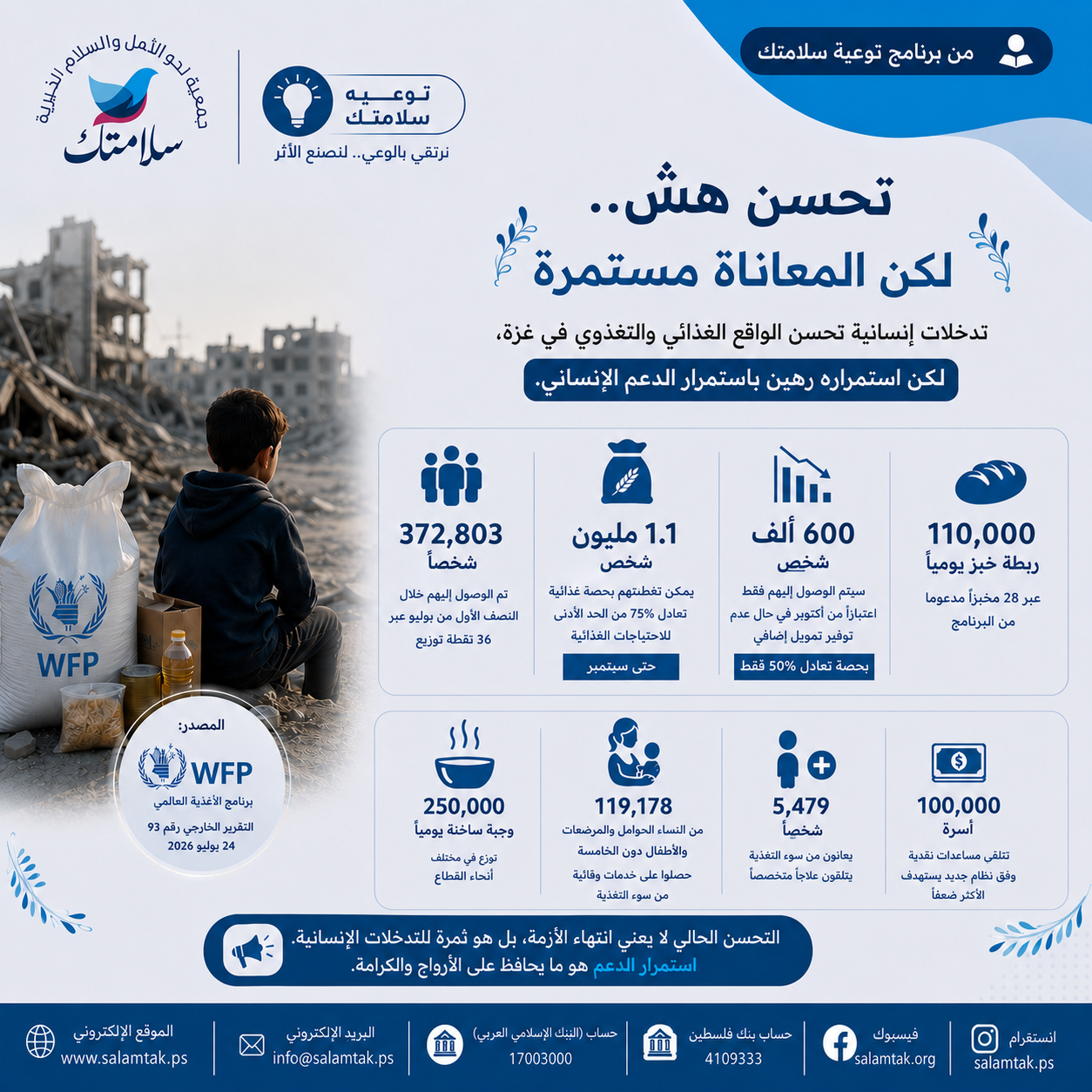
📌 372,803 people received food assistance during the first half of July through 36 distribution points.
📌 The World Food Programme currently has sufficient resources to provide food assistance for 1.1 million people, covering 75% of the minimum food requirements. However, these resources are expected to last only until September.
📌 Without additional funding, food assistance is expected to decline starting in October, reaching only 600,000 people with food rations covering no more than 50% of minimum basic food needs.
📌 Approximately 110,000 bundles of bread are produced daily through 28 WFP-supported bakeries, alongside the daily distribution of 250,000 hot meals across the Gaza Strip.
📌 Nutrition programmes have reached more than 119,000 pregnant and breastfeeding women and children under the age of five, while 5,479 people suffering from malnutrition are receiving specialized treatment services.
However, the report's most significant message lies beyond these figures.
The current improvements are not the result of recovering livelihoods or functioning local markets, but rather of sustained humanitarian interventions. This means that any reduction in funding or humanitarian access could quickly reverse the progress achieved over recent months.
Maintaining these gains requires continued humanitarian support, sustained access for aid delivery, and the creation of conditions that enable families to restore their livelihoods and rebuild their capacity to become self-reliant.
Details
- Blog category salamtak Awareness
- Added at 2026-07-27