







Psychological Support: A Pillar of Recovery
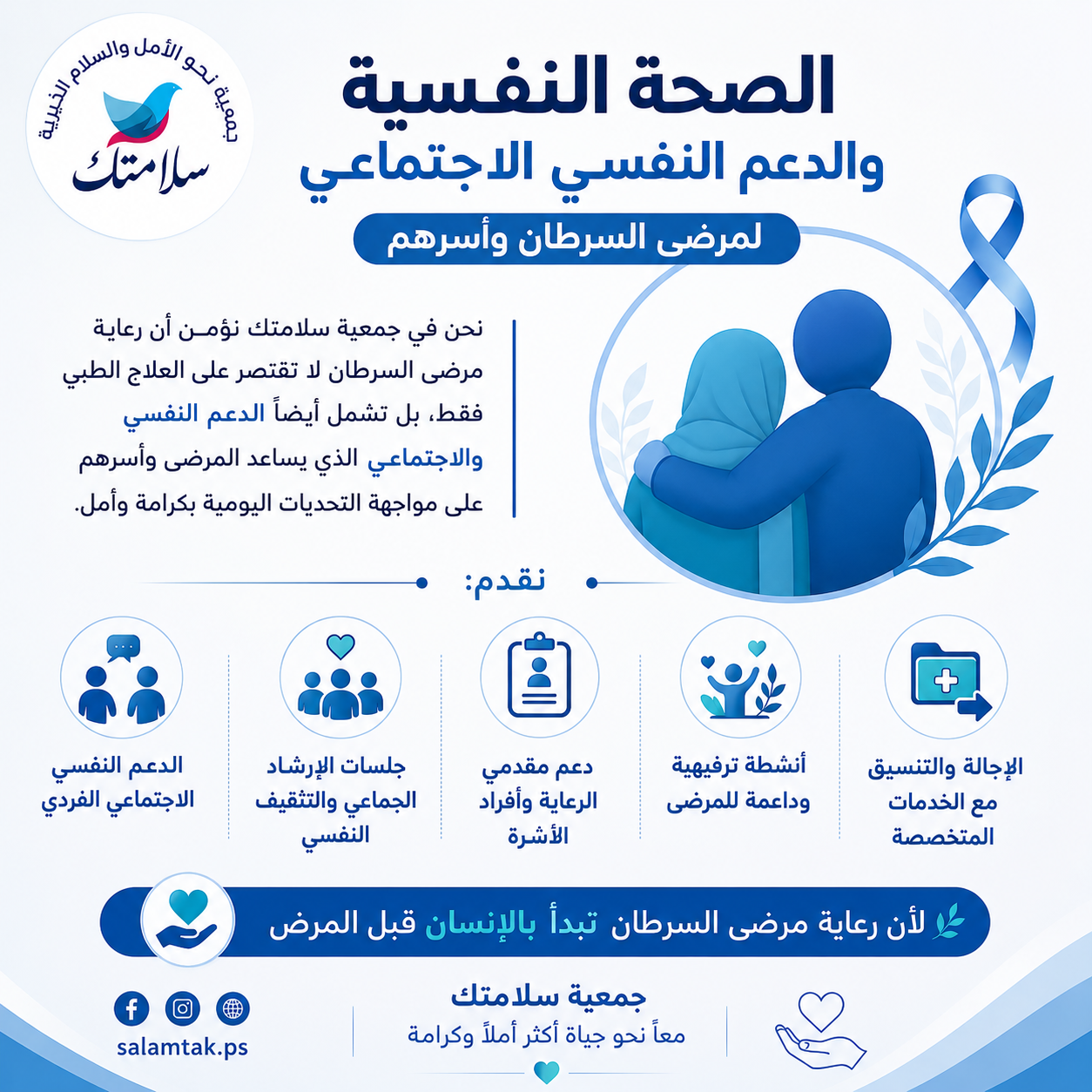
Psychological Support: A Pillar of Recovery
A comprehensive community program fostering dignity, resilience, and psychosocial support for cancer patients and their families.
Cancer care is not only medical care. It is also dignity, emotional support, family resilience, and safe access to services.
Introduction
For cancer patients in Gaza, the journey of illness is not limited to diagnosis, treatment, chemotherapy, surgery, or medication. It is also a journey marked by fear, uncertainty, displacement, financial hardship, family stress, loss of privacy, interrupted access to treatment, and deep emotional pressure.
At Salamtak Association, we believe that cancer care must be comprehensive, dignified, and people-centered. A patient living with cancer needs medical treatment, but also needs someone to listen, accompany, guide, reassure, and support them and their family throughout the treatment journey.
This is why Salamtak integrates Mental Health and Psychosocial Support (MHPSS) into its cancer-related services as a core part of care, not as a separate or secondary activity.
Why MHPSS Matters for Cancer Patients in Gaza
Cancer patients in Gaza face multiple and overlapping forms of vulnerability. Many patients experience fear of disease progression, anxiety before treatment sessions, distress caused by hair loss or body changes, worry about their children and families, and frustration due to delays or interruptions in treatment.
The humanitarian crisis has further intensified these pressures. Patients and families may be displaced, unable to afford transportation, separated from support networks, or forced to seek treatment under highly stressful and unstable conditions.
For many patients, the psychological burden of cancer is increased by:
• Uncertainty about treatment continuity.
• Fear of pain, relapse, or disease progression.
• Loss of income and increased family dependency.
• Physical changes caused by chemotherapy or surgery.
• Exhaustion among caregivers and family members.
• Social isolation and reduced community support.
• Limited access to specialized mental health services.
• The wider trauma of war, displacement, and loss.
In this context, MHPSS is not optional. It is an essential part of preserving dignity, improving coping, supporting treatment adherence, and reducing isolation.
Salamtak’s Program Approach
Salamtak’s MHPSS program is designed as a community-based psychosocial support model for cancer patients, survivors, caregivers, and families.
The program is built on four principles:
1. Integrated Care
MHPSS is linked with Salamtak’s wider services, including cancer patient transportation, medical navigation, palliative care, rehabilitation, wound care, community outreach, and referral.
2. Dignity and Respect
Every patient is treated as a person with emotional, social, family, and spiritual needs, not only as a medical case.
3. Family-Centered Support
Cancer affects the whole family. Salamtak supports not only patients, but also caregivers, companions, and family members.
4. Safe Referral and Coordination
Cases requiring specialized mental health, protection, medical, or social services are referred through safe and appropriate pathways in coordination with relevant partners.
This approach is aligned with the wider purpose of the “Stronger Together” MHPSS Fair, which aims to strengthen integration of MHPSS across humanitarian sectors and promote coordination, referral, and exchange of experience among partners.
Core Components of Salamtak’s MHPSS Services
1. Individual Psychosocial Support
Salamtak provides individual psychosocial support for cancer patients who experience emotional distress, fear, anxiety, sadness, uncertainty, or difficulty coping with illness and treatment.
These sessions provide a safe and confidential space where patients can express their concerns, understand their emotions, and receive basic psychosocial support adapted to their needs.
Individual support may include:
• Active listening and emotional support.
• Psychological first aid when needed.
• Support for patients dealing with fear, stress, or sadness.
• Guidance on coping with treatment-related anxiety.
• Support for patients facing pain, fatigue, or disease progression.
• Identification of cases requiring specialized referral.
• Follow-up for highly vulnerable patients.
The aim is not only to reduce distress, but also to help patients feel heard, respected, and accompanied.
2. Group Counselling and Psychoeducation
Salamtak has implemented group counselling and psychoeducation activities through its psychosocial support space. These sessions help patients and caregivers understand common emotional reactions to cancer, share experiences, and learn simple coping strategies.
Group sessions may address topics such as:
• Coping with cancer diagnosis.
• Managing fear before chemotherapy.
• Dealing with uncertainty.
• Supporting emotional resilience.
• Understanding stress and anxiety.
• Communicating with family members.
• Maintaining hope without denying reality.
• Living with treatment side effects.
Group work helps reduce isolation. It allows patients to realize that they are not alone in their fears and challenges.
3. Peer Support
Peer support is a key part of Salamtak’s approach. Cancer patients and survivors often gain strength from speaking with others who have passed through similar experiences.
Through peer support, patients can:
• Share their journey with others.
• Learn practical coping strategies.
• Reduce feelings of loneliness.
• Build confidence and hope.
• Receive emotional support from people who understand the experience.
• Strengthen social connections.
For women surviving breast cancer, peer support can be especially powerful in addressing sensitive issues such as body image, hair loss, femininity, family roles, and fear of recurrence.
4. Support for Caregivers and Family Members
Caregivers are often the hidden front line of cancer care. They accompany patients, manage appointments, provide emotional support, search for medicine, arrange transportation, care for children, and carry heavy emotional responsibility.
Salamtak recognizes that caregivers also need care.
The program provides awareness and psychosocial support for family members and companions, focusing on:
• How to support a cancer patient emotionally.
• How to listen without judgment or pressure.
• How to communicate with kindness and clarity.
• How to reduce blame, fear, and silence within the family.
• How to recognize caregiver stress and burnout.
• How caregivers can protect their own wellbeing.
• How to support children affected by a parent’s illness.
Supporting caregivers improves the wellbeing of both the patient and the family.
5. MHPSS within Palliative Care
Salamtak’s experience in palliative care shows that patients with advanced cancer need much more than clinical follow-up. They need comfort, dignity, emotional presence, family support, and compassionate communication.
MHPSS within palliative care may include:
• Emotional support for patients with advanced illness.
• Support for families facing fear, grief, and uncertainty.
• Helping patients express their needs and wishes.
• Supporting dignity and comfort.
• Reducing loneliness and emotional suffering.
• Linking families with appropriate health and social services.
• Supporting caregivers during difficult stages of illness.
For Salamtak, palliative care is not only about managing pain. It is about caring for the whole person.
6. Recreational and Therapeutic Activities
Salamtak has implemented recreational and psychosocial activities for cancer patients in public and community spaces. These activities are not only entertainment. They are part of psychosocial support.
Recreational activities help patients:
• Break isolation.
• Experience moments of joy and relief.
• Build social relationships.
• Reduce stress and emotional pressure.
• Reconnect with life beyond illness.
• Feel seen, valued, and included.
• Share positive moments with others.
Salamtak also aims to expand recreational and supportive activities for patients receiving chemotherapy at Al-Shifa Hospital and Nasser Hospital, as part of a more humane treatment journey.
These activities may include light group activities, messages of hope, relaxation exercises, caregiver awareness, and simple psychosocial support during waiting times.
Specialized Support for Women Surviving Breast Cancer
Karama Center
One of Salamtak’s key future priorities is the establishment of Karama Center for Women Surviving Breast Cancer.
Karama Center is designed as an integrated dignity and psychosocial support service for women who have survived breast cancer or are currently receiving chemotherapy and experiencing hair loss, body image distress, or emotional challenges related to treatment.
The center will combine:
• Specialized psychosocial support.
• Peer support groups.
• A safe women-friendly beauty and dignity space.
• Wigs for women experiencing hair loss.
• Breast prostheses for women after mastectomy.
• Support around body image and self-confidence.
• Family awareness and caregiver guidance.
• Referral to additional services when needed.
A woman surviving cancer does not only need to survive medically. She also needs to recover emotionally, socially, and with dignity.
Hair loss, mastectomy, chemotherapy, and changes in body image can deeply affect a woman’s sense of identity, confidence, privacy, and social participation. Through Karama Center, Salamtak aims to provide a compassionate and culturally appropriate service that helps women feel respected, supported, and less alone.
Salamtak’s Experience in MHPSS
Salamtak has practical experience in providing psychosocial support to cancer patients and their families through its psychosocial support space at the association’s premises.
This experience has included:
• Individual psychosocial support sessions.
• Group counselling.
• Peer support activities.
• Awareness for caregivers and companions.
• Supportive recreational activities.
• Psychosocial support linked to palliative care.
• Community-based activities for cancer patients.
This experience forms the foundation for Salamtak’s future development of a more structured, regular, and specialized MHPSS program for cancer patients in Gaza.
Integration with Salamtak’s Wider Cancer Care Model
Salamtak’s MHPSS services are connected to the association’s broader model of support for cancer patients.
Cancer Patient Transportation
Many patients experience anxiety and distress before reaching treatment. Salamtak’s transportation service is not only a logistical service; it is also an opportunity to identify vulnerable patients, provide reassurance, and support safe access to care.
Medical Navigation
Patients often need guidance to understand where to go, what to prepare, and how to follow up. Medical navigation reduces confusion and stress.
Palliative Care
Patients with advanced illness require emotional support, family support, and dignified care.
Rehabilitation and Wound Care
Patients with physical limitations, wounds, amputations, or functional difficulties may also experience psychological distress. MHPSS helps support adaptation and recovery.
Community Outreach
Through outreach, Salamtak can identify patients who are isolated, displaced, or unable to access services.
By connecting these services, Salamtak promotes a comprehensive model of care that responds to the medical, psychological, social, and practical needs of cancer patients.
Referral and Case Follow-Up
Salamtak recognizes that some cases require more specialized support than community-based psychosocial services can provide.
Therefore, the program includes identification and referral of cases needing:
• Specialized mental health care.
• Protection services.
• Gender-based violence support.
• Child protection support.
• Medical follow-up.
• Rehabilitation services.
• Social assistance.
• Palliative care.
• Legal or family support services where available.
Salamtak seeks to strengthen coordination and referral pathways with MHPSS, health, protection, and other humanitarian actors.
Future Development Priorities
1. Expanding the Psychosocial Support Center
Salamtak plans to further develop its existing psychosocial support experience at the association’s premises into a more structured service with regular sessions, clear tools, case follow-up, and referral mechanisms.
2. Establishing Karama Center
Karama Center will provide integrated dignity and psychosocial support services for women surviving breast cancer.
3. Supporting Patients During Chemotherapy
Salamtak aims to provide light psychosocial and recreational activities for patients receiving chemotherapy at Al-Shifa Hospital and Nasser Hospital.
4. Strengthening Caregiver Support
The association will expand awareness and support activities for caregivers, companions, and family members.
5. Building Peer Support Groups
Peer support groups will be developed for cancer patients, survivors, women with breast cancer, and caregivers.
6. Strengthening Referral Coordination
Salamtak will continue working with partners to develop safe referral pathways for patients requiring specialized MHPSS, protection, health, or social services.
7. Improving Documentation and Learning
Salamtak aims to document service delivery, beneficiary feedback, lessons learned, and emerging needs to support evidence-based programming and advocacy.
Opportunities for Partnership
Potential Areas of Collaboration
• Referral of cancer patients in need of psychosocial support.
• Technical support for MHPSS service development.
• Training of Salamtak staff and volunteers.
• Support for Karama Center.
• Provision of wigs and breast prostheses.
• Support for caregiver awareness sessions.
• Joint recreational and psychosocial activities in hospitals.
• Development of safe referral pathways.
• Support for palliative care and family counselling.
• Research, documentation, and evidence generation.
Our Message
Cancer patients in Gaza are not only fighting disease. They are also facing fear, displacement, uncertainty, financial hardship, and the emotional weight of interrupted care.
At Salamtak, we believe that every cancer patient deserves more than treatment. They deserve to be heard, accompanied, respected, and supported with dignity.
SALAMTAK’S MESSAGE IS CLEAR
Cancer care is not complete without mental health and psychosocial support.
Through its community-based MHPSS program, Salamtak is working to ensure that cancer patients, survivors, caregivers, and families are not left alone during one of the most difficult journeys of their lives.
Details
- Blog category Our activities
- Added at 2026-03-06